
Patent Strategy for Startups: Avoid Early Mistakes and Build Strategic IP
Early-stage founders have a lot on their plates: product development, discovery, and fundraising. It’s no surprise that a startup patent strategy often falls by the wayside. Many startups treat patents as a low priority or a box to check for investors, only to scramble later or make costly mistakes. A well-crafted patent strategy, however, is a growth tool, not a mere formality. In this post, we’ll share how Novitas IP Consulting approaches patent strategy for startups. We will cover common pitfalls and how to turn IP into an asset that supports your product and fundraising milestones.
Why Startup Patent Strategies Often Go Wrong
It’s common for startups to get IP wrong in the early days. Founders are typically laser-focused on building their product and business, so IP planning can feel abstract or premature. Here are a few reasons mistakes happen early on:
- Treating Patents as an Afterthought: Many entrepreneurs delay patent work until an investor or advisor brings it up. One biotech founder admitted, “I wasn’t thinking about patents… It wasn’t until a potential investor asked about our IP strategy that I realized how crucial patents would be to our company’s valuation and future.” This reactive approach leaves startups playing catch-up.
- Lack of Alignment with Business: A major mistake is filing patents in isolation, disconnected from the startup’s actual product roadmap. Patents that don’t map to the company’s core technology or growth trajectory add little value. They can even raise red flags for investors if the filings seem random or irrelevant.
- Filing the Wrong Things: Not every idea deserves a patent. Founders sometimes pursue scattershot filings, patenting minor features or ideas that aren’t central to their value proposition. Investors aren’t impressed by a stack of trivial patents that “miss the central innovation.” They want to see that you’ve protected your core differentiator.
- Rushing In with Weak Applications: Another pitfall is rushing to file a provisional patent solely to obtain a “patent pending” label without providing sufficient detail. A weak provisional application (one that lacks a proper description of the invention) can do more harm than good. If the provisional doesn’t fully teach your invention, your claimed early filing date may be meaningless later. Experienced patent examiners note that filing “something, anything” as a provisional often backfires when you try to convert it to a real patent. It looks sloppy and can undermine investor confidence.
- Waiting Too Long to File: On the flip side, waiting until you’ve disclosed your technology (in a pitch deck, at a conference, on GitHub, etc.) can be a critical error. Public disclosure before filing can significantly hinder your ability to obtain a patent in most countries. (The U.S. has a one-year grace period for your own disclosures, but relying on that is risky for a global startup.) In one cautionary tale, a startup lost patent rights after sharing a demo deck too early without any filings in place. In today’s first-to-file system, delaying a patent filing can also mean a competitor might beat you to the punch.
The good news is that these mistakes are avoidable with the right startup patent strategy. Next, we’ll explore what reactive patenting versus strategic IP planning looks like, so you can ensure your startup takes the smarter path.
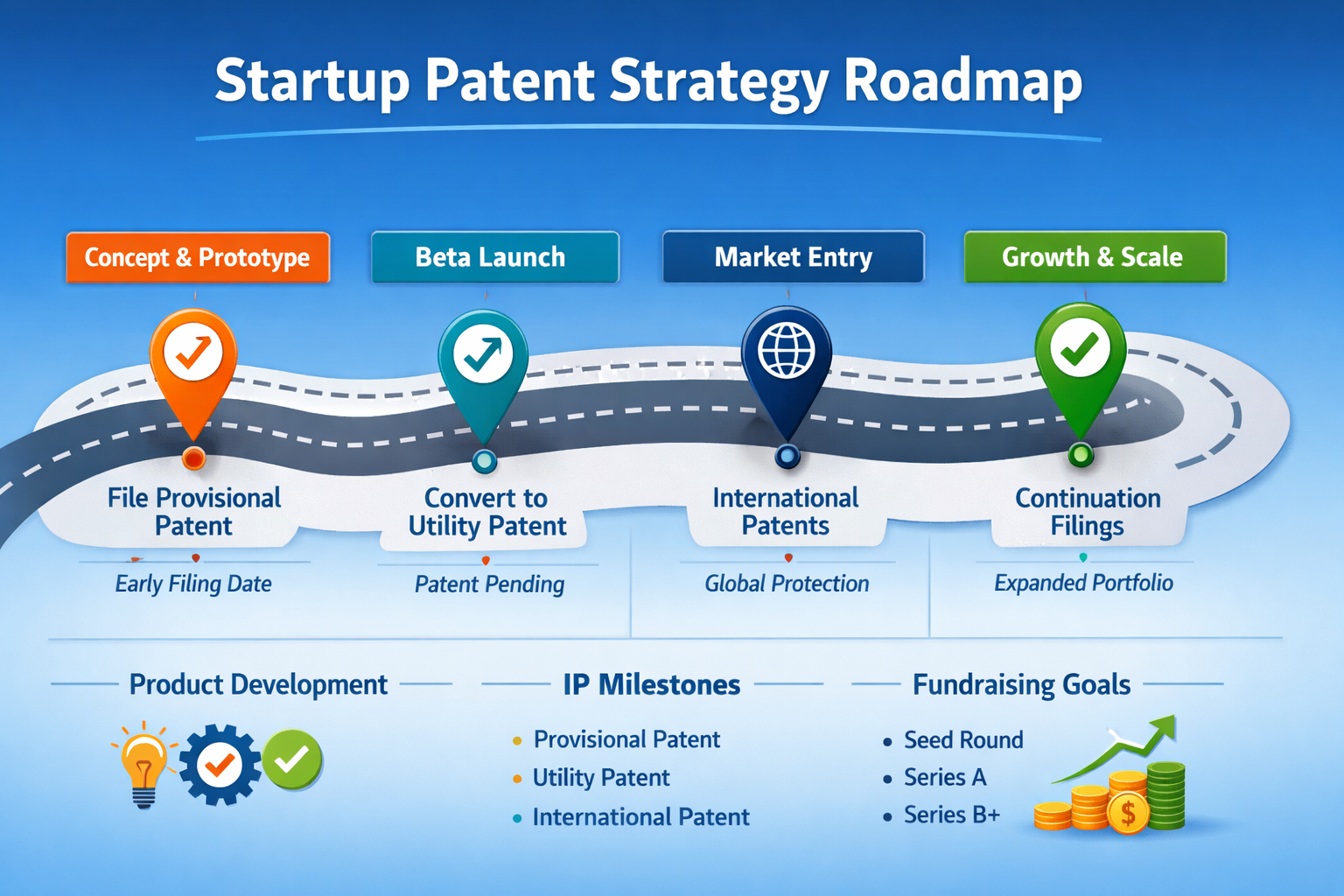
To visualize how patent filings should align with your startup journey, here’s a roadmap that connects product development, IP milestones, and fundraising goals:
Reactive Patenting vs. Strategic IP Planning
It’s important to distinguish reactive patent behavior from a strategic IP plan. A reactive approach is driven by events and fear, whereas a strategic approach is driven by foresight and alignment with your business goals.
- Reactive patenting often happens under duress or external pressure. For example, a startup might rush to file a patent only when a competitor announces a similar product, or because an investor asked tough questions about IP during due diligence. Reactive filings are typically last-minute and not well-aligned to a broader plan. They can result in hasty, low-quality patents that “drain resources” without providing a real competitive advantage. In short, it’s a defensive, short-term mindset.
- Strategic IP planning, in contrast, means integrating patents into your business strategy from the start. Rather than one-off filings, you develop an IP roadmap that mirrors your product roadmap and fundraising milestones. Every patent has a purpose: protecting core technology, securing a competitive moat, or signaling value to investors. Strategic planning is proactive. For instance, you might plan a pipeline of filings (provisional to non-provisional, follow-on continuations, international applications) that evolves as your product evolves. This approach treats patents as business assets that grow with the company, not as reactive insurance policies.
The difference between reactive and strategic approaches is stark. As one former USPTO patent examiner observed after seeing many startup patent portfolios, “the difference comes down to strategy.” Those with a thoughtful strategy impressed investors and set the stage for growth, while scattershot approaches “did little more than drain resources.” In other words, planning pays off.
When and What to File, and What to Avoid
A frequent question founders ask is “What should we patent, and when?” Equally important is knowing what not to patent or when to hold off. Here are some guidelines to help you prioritize:
- Protect Your Core Innovation First: Focus your early patent efforts on the technology or feature that truly sets you apart. Not all ideas need patents. Start with the invention that underpins your competitive advantage. If you’re a software startup with a breakthrough algorithm, patent that algorithm (and related methods), not just a cosmetic UI feature. By patenting the engine of your business, you create real value. Everything else can follow.
- Time Filings with Key Milestones: Timing matters for startups. You should synchronize major patent filings with your product launches and fundraising rounds when possible. For example, filing a provisional patent before a big public demo or before closing an investment round can be wise. It lets you safely discuss your tech (with “patent pending” status) and shows investors you’re proactive about IP. Conversely, avoid filing too far in advance of a product if the concept is likely to pivot significantly. You might waste money on patents for a product that changes direction. Align filings to the roadmap so they “align with products, markets, and investor milestones.” This ensures your IP supports your next steps instead of creating drag.
- Use Provisionals Strategically (Don’t Wing It): Provisional patent applications are a startup’s friend; they’re relatively low-cost and let you secure an early filing date while you refine your invention. We often advise founders to file a provisional once they have a clear breakthrough and before any public disclosure. However, a provisional is only as good as what you put in it. Don’t file a one-page sketch or vague idea just to get a date. If the provisional lacks enabling detail, it won’t fully protect you. Take the time to include a solid description of how your invention works. Think of a provisional as a draft patent application; treat it seriously. A well-prepared provisional can be converted to a strong utility patent later; a flimsy provisional might “raise doubts” and give a false sense of security.
- Avoid Public Disclosures Before Filing: This bears repeating: if you need to talk about or demo your technology outside the company, file at least a provisional first whenever possible. Pitching to investors, publishing a whitepaper, or even posting on a forum can count as public disclosure. Once something is public, you could lose foreign patent rights forever. If you absolutely must disclose (e.g., for user testing or a pitch) and can’t file in time, use non-disclosure agreements and limit details. But the safest route is to file early on anything core before you go public. It preserves your options globally and prevents the nightmare scenario of someone else patenting your own idea.
- Be Selective – Don’t Patent Everything: Startups have limited budgets, and patent filings aren’t free. A strategic portfolio is high-quality, not high quantity. Avoid the temptation to claim every feature or idea. As noted, investors won’t be impressed by a shotgun approach that yields a bunch of weak patents. Each patent should earn its keep. Ask yourself: Does this filing meaningfully protect my business or move the needle for investors? If not, skip it or save it for later. It’s often better to have a few solid patents that cover the heart of your innovation than dozens of filings on marginal ideas. Likewise, keep an eye on maintenance costs down the road; a lean, relevant patent portfolio will serve you better than a bloated one.
By filing smartly, on the right things, at the right time, you’ll build an IP foundation that is both effective and efficient. Next, let’s talk about what happens after you file, and how an examiner-informed strategy can further save you time and money.
Leveraging Examiner Insights to Save Time & Money
Filing a patent application is just the beginning. What follows is the patent prosecution process: working with the USPTO examiner to get your patent allowed. This phase can be lengthy and expensive if not handled well. That’s why Novitas emphasizes an examiner-informed strategy, in other words, approaching patent prosecution with an understanding of how examiners think and operate.
Here’s why that matters for startups’ time and budget:
- Most Applications Face Pushback: Statistically, about 9 out of 10 patent applications receive at least one rejection from the examiner. This is normal; examiners are doing their job to ensure only novel, non-obvious inventions get through. But many first-time inventors are unprepared for this reality and end up burning cash on multiple rounds of responses. It’s important to anticipate that getting a patent is a negotiation, not a one-and-done filing. Knowing this, Novitas prepares robust initial applications (to preempt obvious rejections) and plans for possible objections. We see patent prosecution as a collaborative problem-solving process with the examiner, not an adversarial fight.
- Insight Reduces Iterations: There’s a saying: work smarter, not harder. An examiner-informed approach means we leverage insights into the USPTO process to streamline examination. For example, conducting an examiner interview early in the process can clarify misunderstandings and resolve issues faster than back-and-forth papers. In an interview, you (or your patent practitioner) talk directly with the examiner to home in on allowable subject matter or clarify technical points. These dialogues often expedite prosecution, potentially shaving months off the timeline. Faster allowance not only saves time but also legal fees; each cycle of written responses costs money.
- Former Examiner Perspective: Our team at Novitas includes professionals with USPTO examiner experience. This insider perspective is a huge asset for startups. Experienced patent practitioners understand how examiners think and what they look for, and they adapt their strategy accordingly. For instance, if we know a particular examiner (or art unit) tends to reject broad software claims, we might draft claims a bit narrower or prepare strong fallback positions from the start. If we anticipate a certain type of prior art search, we ensure our application addresses those angles. By aligning with the examiner’s expectations and requirements, we avoid unnecessary friction. The result: fewer office actions, quicker grants, and lower overall cost to you.
- Quality Over Quantity (again): Part of saving time and money is getting it right the first time. A well-crafted application that is clear, well-supported, and strategically claimed is more likely to proceed smoothly. This goes back to having a solid strategy (as emphasized earlier). Patents drafted with foresight tend to need fewer drastic amendments later. Our examiner-informed mindset ensures each application is prosecution-ready, not just a rough draft thrown over the wall. We aim for allowable patents with minimal rounds, because that type of efficiency directly benefits a resource-conscious startup.
In short, working smartly with examiners, through preparation, communication, and expert insight, can significantly accelerate your patent journey and reduce costs. For a startup racing against the clock (and burn rate), this is key. You want your patents granted on time and without breaking the bank on attorney fees. An examiner-informed strategy helps achieve that by avoiding the common pitfalls that lead to drawn-out battles with the USPTO.
How to Align Your Startup Patent Strategy with Product and Fundraising
One of the core philosophies at Novitas IP Consulting is that patents should serve your business strategy, not the other way around. We help founders align their patent activities with their product development and fundraising timelines. Why is this so important? Because a patent strategy is truly valuable only when filings align with your products, markets, and investor milestones.
Consider how patents can bolster your startup at various milestones:
- Product Development: As you reach significant R&D milestones or prepare for a product launch, having patent protection in place is crucial. For example, before you unveil a breakthrough feature or technology in your product, you’ll want a patent application on file for it. This not only protects you from copycats once you launch, but it also allows you to market your product as “patent pending,” which can be a selling point. We ensure your patent roadmap is synchronized with your product roadmap, and each key feature or innovation is evaluated for protection at the right time. Essentially, your patents map directly to your company’s growth trajectory. Nothing is filed in a vacuum. If an idea or feature is not part of your plan or pivot, we won’t waste your resources on it. Conversely, if a core technology is about to hit the public, we make sure you’re covered.
- Fundraising Rounds: Investors pay close attention to IP in due diligence. A startup that can show a structured patent portfolio (e.g., a couple of pending applications and maybe an issued patent, all tied to the product roadmap) will inspire more confidence than one with either no IP or a pile of unrelated filings. In fact, a mix of pending and granted patents mapped to your roadmap signals that you’re thinking ahead about growth and defense. Patents become part of your value story during fundraising: they demonstrate that if your technology succeeds, you’ll have legal ownership and exclusivity around it.
- This can positively impact valuation and terms. Studies have shown that startups with strong patent positions tend to secure more funding at higher valuations. Even at early stages, just having a credible patent pending on your core tech can set you apart. Novitas helps time your filings so that, say, by your Series A, you have a significant patent in prosecution or issued, aligning with investor expectations at that stage. We also ensure all IP is properly assigned to the company and ownership is clear, so there are no red flags in diligence (investors “don’t want to buy into a lawsuit” over who owns the IP).
- Growth and Scaling: As your company grows, so should your IP strategy. We help you plan for continuations and international filings when appropriate, extending protection as you enter new markets or iterate on your product. This shows an “enforcement mindset” and long-term thinking that savvy investors and partners appreciate. Rather than a static one-and-done patent, you build a defensive wall over time. And importantly, we revisit the plan at each milestone, for instance, before entering a new market or before a major partnership, to see if additional IP filings or freedom-to-operate analyses are needed to protect and enable those moves.
In aligning patents with business milestones, the overarching goal is to make your IP work in tandem with your company’s development. Done right, patent strategy reinforces your product strategy and your financing strategy. Each patent has a clear business justification: either protecting a revenue stream, creating leverage, or adding credibility when it’s most needed. As a result, you’re not spending money on patents for their own sake (no vanity patents); you’re investing in building a moat around your company at the moments it matters most.
Get Strategic with Your Startup’s IP (Call to Action)
The bottom line is that a thoughtful IP strategy can be a game-changer for a startup. It’s not about fear or ticking a box, it’s about proactively shaping your competitive edge and narrative. Patents, when approached strategically, become shields and levers for growth, not just legal documents.
Novitas IP Consulting is here to help you make that happen. We specialize in working with founders and early-stage teams to demystify the patent process and integrate it with your business plan. Whether you’ve been patent-shy or dabbled in filings already, our perspective as both former examiners and startup IP strategists can add value to your journey.
Ready to fortify your startup’s innovation? Let’s talk. Reach out to schedule a conversation with our team about your startup’s patent strategy and IP preparedness. Don’t let your startup’s next milestone arrive without an IP plan in place. A little strategic foresight now can save countless headaches later and set you up for long-term success.
Let’s align your patents with your product vision and growth goals and build that strong IP foundation from day one. Get in touch with Novitas IP Consulting today. We’re excited to support your journey.